A Murder in Mexico
The murder of Mexico’s police chief signals just how serious the Mexican drug trafficking organizations are about taking on the Mexican state. And just how weak the Mexican state is.
“This could have a snowball effect, even leading to the risk of ungovernability,” Luís Astorga, a Mexico City-based sociologist and drug expert, said in an interview. “It indicates terrible things, a level of weakness in our institutions—they can’t even protect themselves.”
By most accounts the police chief, Edgar Eusebio Millan Gomez, was a good cop trying to do an impossible job-fighting drug organizations that have more resources, better weapons and the ability to buy or kill those that oppose them.
President Felipe Calderon also wins high praise for sharply ratcheting up the pressure on the trafficking organizations, who have responded in the most predictable and lethal fashion-murdering high-profile symbols of the enforcement effort.
It is worth remembering that the chaos the traffickers are wreaking in Mexico is not just aimed at the Mexican state, it is also aimed at undermining the already-battered viability of our southern border. The hundreds of dead across the border states of Mexico show where the battles are being fought.
The easier it is to cross dope, weapons, illegal aliens from around the world, the higher the profits for the traffickers.
And the FARC rebels in Colombia are now in a direct business relationship with Mexican trafficking organizations, according to the recently-captured FARC documents resulting from the raid that killed rebel leader Raul Reyes.
The FARC, in turn, is allied with Nicaragua (Ortega) and Venezuela (Chavez), who in turn are allied with Iran, which in turn runs Hezbollah, which in turn is actively working to expand its beach head in Latin America.
It is not a conspiracy to see all these developments as inter-connected. As I often tell military audiences and others, every piece of the mosaic, looked at individually, is serious but not alarming. But when the tiles of the mosaic are assembled into a picture, even if the picture is a bit blurry, it is astonishing and dangerous.
The Colombians have been through this (the assassination of an attorney general and three top-tier presidential candidates in the span of three years in the 1980s), and have paid a tremendous price for taking on the cartels and criminal/political groups like the FARC. The effort, however, has paid off in the destruction or significant weakening of the groups, to the point where they no longer represent a direct challenge to the state.
Mexico is at the beginning of a cycle that will likely get worse before it gets better. The allies of the Mexican cartels are stronger and more vicious than those of the Medellin and Cali cartels in Colombia.
If the spread of these lethal armies, now controlling territory from Colombia, through Central America, up the Caribbean coast to our borders, are not understood to be a tier-one security threat-both as organized crime and terrorist operations-we will pay a very heavy price indeed.
Bad Omens in Latin America
The Associated Press today reports on how thinly spread U.S. Special Forces are in many parts of the world, including Latin America, at a crucial time.
“We’re going to fewer countries, staying for shorter periods of time, with smaller numbers of people than historically we have done,” Adm. Eric T. Olson said May 5 in his first interview since becoming commander of U.S. Special Operations Command last July.
To illustrate that point, Olson said that when the 7th Special Forces Group, which is based at Fort Bragg, N.C., and whose normal area of focus is Latin America, rotates into Afghanistan for seven-month tours, it takes two of its three battalions, leaving just one in Latin America.
“That leaves us underrepresented” in Latin America, the admiral said.
In Latin America, as in other areas of greatest interest to the Special Operations Command, Green Berets deploy to friendly countries like El Salvador or Colombia to train local military forces.
Special operations units that are designated mainly for use in Africa and Europe, Olson said, also are under strength for their normal role in those regions because they, too, are tied up in Iraq and Afghanistan.
Since the U.S. invaded Iraq in March 2003, about 80 percent of the overseas deployments of special operations forces have been to the Middle East and Afghanistan, Olson said. That compares with 20-25 percent before Sept. 11, 2001.
At the same time, the Reuters news agency reports on growing concerns about the Iranian presence in Latin America.
It noted the growing Iranian presence in Venezuela, Bolivia, Ecuador and Nicaragua, which I have discussed extensively before.
“We are worried that in the event of a conflict with Iran, that it would attempt to use its presence in the region to conduct such activities against us,” Thomas Shannon, the U.S. assistant secretary of state for the Western Hemisphere, told Reuters.Left-wing governments in Venezuela, Cuba, Nicaragua and Bolivia have all become allies of Iran in recent years, and other countries in Latin America have diplomatic ties with the Islamic republic.
Shannon said Iran wants to ease its international isolation by showing it is able to win friends in Latin America, which has been historically in the United States’ “sphere of influence.”
The juxtaposition of these two points to some of the alarming gaps that have developed in our ability to deal with virtually anything beyond the immediate spheres of Iraq and Afghanistan.
In addition to having no hard power to deploy in the region, should it be necessary, we are being vastly outspent and out-flanked on the soft power side, leaving the field almost unchallenged to Iran, China and others who do not have the same geographic or historic ties to the region.
Latin America is in serious jeopardy of seeing years of democratic reforms sharply reversed, in ways that are detrimental both to the populations of the region and US strategic interests.
I lived through the bleak periods of military dictatorship in Bolivia and covered the wars in Central America, and have some understanding of how profoundly different the region is from those periods.
It will be a serious situation when those gains begin to erode to the point of collapse.
Comment [4]
Viktor Bout Indicted on Charges of Seeking to Kill U.S. Citizens
The Justice Department today unsealed a four-count indictment of Russian weapons trafficker Viktor Bout, charging him with the following:
“Between November 2007 and March 2008, Bout agreed to sell to the FARC millions of dollars’ worth of weapons—including surface-to-air missile systems (SAMs), armor piercing rocket launchers, AK-47 firearms, millions of rounds of ammunition, Russian spare parts for rifles, anti-personnel land mines, C-4 plastic explosives, night-vision equipment, “ultralight” airplanes that could be outfitted with grenade launchers and missiles, and unmanned aerial vehicles. Bout agreed to sell the weapons to two confidential sources working with the DEA (the CSs), who represented that they were acquiring these weapons for the FARC, with the specific understanding that the weapons were to be used to attack United States helicopters in Colombia.”
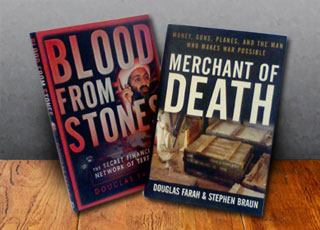
The full indictment can be read here. Bout, known as The Merchant of Death and subject of a book by the same name by me and my co-author, Steve Braun, was arrested in Thailand on March 6.
He is still in prison outside Bangkok, and the US government, or at least parts of it, are pressing hard for his extradition. If convicted, Bout would face a life sentence.
As with his dealings with the Taliban, Bout was not bashful about promising to deliver lethal weapons to a terrorist group (the FARC, or Fuerzas Armadas Revolucionarias de Colombia) have been on the US terrorist list since 1997 and on the EU list since 2001.
The day of his arrest, according to the indictment, Bout agreed to sell to confidential DEA sources 700-800 surface-to-air missiles; 5,000 AK-47 assault rifles; millions of rounds of ammunition; spare parts for the rifles; anti-personnel land mines and C-4 explosives; night vision equipment; “ultra-light plane which could be outfitted with missiles and grenade launchers; and unmanned aerial vehicles with a range of 200 to 300 kilometers.
Not a bad shopping list for $15 million to $20 million, as Bout requested.
During the meeting, Bout allegedly said that the “United States was also his enemy,” and, when informed the weapons would be used to kill U.S. troops in Colombia, said the fight against the United States was also his fight, so he would supply the FARC with the weapons.
Perhaps that will be enough to put some spine into those waffling on the US side, hoping to negotiate Bout for some large strategic concession from Russia.
It may be time for them to recognize that Bout is a serious enough threat that he should be non-negotiable.
Comment [6]
The Tragedy of the USS Cole Case
The Washington Post this weekend carried an extensive and depressing look at how the main suspects in the USS Cole bombing have gone free.
The most infuriating piece is on the freedom of Jamal al-Badawi, who helped organize the October 2000 attack on the US battleship that left 17 sailors dead.
It was a bold attack, and one that should never have succeeded. The hesitancy by the crew to inflict potential civilian casualties cost the lives of soldiers in an era when the armed forces were not yet used to suicide bombing.
It is important to recognize the role bringing perpetrators of violent acts to justice plays in fighting radical Islamists or any other terrorist group, or rather the tremendously high price we pay for impunity.
Impunity in these cases, especially with the complicity of senior government officials (in this case, in Yemen) will, without a doubt not only contribute to emboldening would-be terrorists for future attacks. It also contributes greatly to the jihadist (with apologies to the authors of the much commented-on and rightly condemned DHS memo on language use) narrative of their struggle.
There is no doubt that the US government’s conduct in the initial investigation left much to be desired. Lack of cultural training and knowledge and lack of trust made it a difficult task from the beginning.
But that is not the real reason for the unraveling of the case, and there is plenty of responsibility to be shared by all sides. The lack of sustained interest by the Bush administration, Yemeni authorities who view the attacks as less than important, and the weak and corruptible judicial system all are factors.
As the story noted:
In March 2002, President Bush said his administration was cooperating with Yemen to prevent it from becoming “a haven for terrorists.” He added: “Every terrorist must be made to live as an international fugitive with no place to settle or organize, no place to hide, no governments to hide behind and not even a safe place to sleep.”
Since then, Yemen has refused to extradite Badawi and an accomplice to the United States, where they have been indicted on murder charges. Other Cole conspirators have been freed after short prison terms. At least two went on to commit suicide attacks in Iraq.
“After we worked day and night to bring justice to the victims and prove that these Qaeda operatives were responsible, we’re back to square one,” said Ali Soufan, a former FBI agent and a lead investigator into the bombing. “Do they have laws over there or not? It’s really frustrating what’s happening.”
The answer is, there are not laws as we understand them, and the attack is widely viewed in the Muslim world (again, a nod to DHS) as a successful act of jihad against the infidel.
(One can quickly see the brilliance of the DHS Muslim advisers in their recommendations, as it soon becomes virtually impossible to write, in any meaningful or intelligent way, about radical Islamism and what it means. Yes, words do matter, and now they have appropriated all the words. Truly brilliant.)So now Badawi and others who perpetrated and were convicted of the Cole attack are free so they can help turn over al Qaeda operatives.
It would be interesting to know how that has worked out. Of course, it may be a little hard to ascertain as Badawi and his fellow attackers seem to come and go from jail as they choose. Perhaps they turn in periodic written intelligence reports, or simply report directly to the warden of the maximum security jail they are able to wander in and out of at will.These stories of escape and impunity have deep resonance in the jihadist world, and make a mockery of the promises routinely issued to bring those responsible to justice. It is better not to make those promises than to make them only so they can be shown to be hollow.
Comment [6]
An Interesting Pairing at a Conference
It is interesting to note that CAIR director Nihad Awad will soon be sharing center stage in a major conference with Mohammad Akram al-Adlouni, the probable author of the most damning documents made public during the Holy Land Foundation trial.
The conference in Denmark, heavily populated with Muslim Brotherhood figures, is, according the program, to commemorate the 60th anniversary of the Nakbah or catastrophe, as they refer to the founding of the state of Israel.
The joint attendance of Awad and al Adlouni, now head of the al Quds Foundation in Lebanon, was first noted by the Global Muslim Brotherhood Daily Report.
The GMBDR further noted that:
The Palestinian Return Centre in London, characterized by sources in London as close to Hamas, has Trustees that have also been on the board of the Muslim Association of Britain, one of the Muslim Brotherhood organizations in the U.K. The Centre itself has been widely promoted by the U.K Brotherhood. CAIR, in turn, had its origins in the Hamas support infrastructure in the U.S.
So, the old gang is getting together again, in the service of the Muslim Brotherhood and its armed wing, Hamas.
It was al-Adlouni who penned the famous “On the General
Strategic Goal for the Group in North America,” referring to Muslim Brotherhood organizations, including those in which Awad has been active. CAIR was formed later, but comes from the same family of organizations linked to the Ikhwan.
As I wrote in the analysis for the NEFA Foundation, “In the document, the author is strikingly clear
about the ultimate goal of the Muslim Brotherhood in the United States.” The document stated that:
The Ikhwan must understand that their work in America is a kind of grand Jihad in eliminating and destroying the Western civilization from within and “sabotaging” its miserable house by their hands and the hands of the believers so that it is eliminated and God’s religion is made victorious over all other religions.
I will repeat a bit more of the paper here, because it is important to see where this group’s true agenda lies, as these old allies and others of their ideological and theological persuasion meet again, with an agenda largely unchanged from what they articulated 17 years ago and have never renounced:
In order to establish his authority in the Explanatory Memorandum, Adlouni states that his authority is derived from the 1987Shura Council and Organizational Conference of 1987, the highest governing bodies of the Brotherhood in the United States. To claim this authority he quotes the group’s agreed goals from that conference, including:
“Enablement of Islam in North America, meaning: establishing an effective and stable Islamic Movement led by the Muslim Brotherhood which adopts Muslims’ causes domestically and globally, and which works to expand the observant Muslim base, aims at unifying and directing Muslims’ efforts, presents Islam as a civilization alternative, and supports the global Islamic state wherever it is.”
After going into some detail in establishing the relevance and authority of his missive, Adlouni spends considerable time on the fundamental concept of settlement, central to the Muslim Brotherhood-led efforts in North America. He describes settlement as necessary so “That Islam and its Movement become a part of the homeland it lives in.”
The process of settlement isalso defined as follows:“In order for Islam and its Movement to become “a part of the homeland” in which it lives, “stable” in its land, “rooted” in the spirits and minds of its people, “enabled” in the live of its
society and has firmly established “organizations” on which the Islamic structure is built and with which the testimony of civilization is achieved, the Movement must plan and struggle to obtain “the keys” and the tools of this process in carry out this grand mission as a “Civilization Jihadist” responsibility which lies on the shoulders of Muslims and – on top of them – the Muslim Brotherhood in this country…
Comment [5]
AG Mukasey's Overdue Attention to Organized Crime
Almost as soon as my last post on the transnational threat of cigarette smuggling was posted, several alert friends sent me the recent speech by Attorney General Michael Mukasey at CSIS, where he announced a new effort to understand and combat transnational criminal organizations.
The initiative is long overdue. As Mukasey noted, the Organized Crime Council had not met for 15 years. Quite a feat, given the numerous and wide-ranging indications that organized criminal groups have steadily gained influence, power and control or near-control over areas that are vital national security. As Mukasey noted:
International organized crime is a hybrid criminal problem that implicates three of the department’s national priorities: national security, violent crime, and public corruption. It needs a coordinated response and an openness to new ways of doing business. It also demands that we work closely with our foreign colleagues in order to dismantle global criminal syndicates. In short, this is about more than the Department of Justice. It involves our law enforcement and non-law enforcement colleagues at the Departments of Homeland Security, State, Treasury, and Labor, the U.S. Postal Service, as well as the intelligence community. And I’d like to thank these other agencies for their help and for their efforts.
The attorney general’s Organized Crime Council will have a leading role in coordinating that effort.
But one thing was curiously missing from Mukasey’s comments, and that is growing link, as I and others have outlined numerous times, between these organized criminal networks and terrorism, including but not limited to terrorism driven by radical Islamist theology.
Mukasey did mention the case of Viktor Bout and the FARC, which I have written about extensively. But it is hear that Mukasey’s silence is most interesting.
Regarding the Bout case, Mukasey said:
As this example makes clear, although these criminals are not motivated by ideology, when the price is right, they are more than willing to help the people who are motivated by ideology.
That is certainly true. But it can also be people motivated by theology. Bout sold weapons and aircraft to the Taliban, and indirectly armed al Qaeda in Afghanistan. He has helped arm Hezbollah, the Islamic Courts Union in Somalia, and other cases.
All have the stated goal of establishing a radical Islamist government that transcends any nation state, imposes sharia law and ushers in a radically different world.
My point is that what makes transnational criminal organizations more dangerous now transcends the power to corrupt, undermine the legitimate economy and threaten the sovereignty and security of the states in which they operate.
Those issues are clearly vitally important. But the real difference between today and 10 years ago is that criminal groups have not only grown and created pipelines for moving illicit goods, but that terrorist organizations now place people and products in those same pipelines, as I described recently in a paper for the NEFA Foundation.
While criminal organizations are driven by economic considerations, often kill those who stand in their way and challenge the authorities of states in numerous ways, they have not traditionally had, as an objective, the destruction of the West, the toppling of governments and the imposition of a government claiming divine legitimacy.
Yet these criminal groups now provide the infrastructure on which radical political groups (FARC etc.), governments (Iran, North Korea, Venezueal etc.) and radical, expansionist religious groups (al Qaeda, Hezbollah, Hamas etc.) can build.
That is the true difference between our time and the time when the Council stopped meeting. States can-and often but not always do-ultimately meet the challenges of transnational criminal organizations.
But the pipelines that they develop and constantly shift can be used by terrorists who are not interested in money, but in maximizing the number of people they can kill. And that is a whole new world.
Comment [1]
Cigarettes and the Criminal-Terrorist Nexus
The minority staff of the House Committee on Homeland Security has, as first reported by Fox News, posted an interesting report on the ties between cigarette smuggling and terrorism.
The report focuses primarily on smuggling in New York and the billions of dollars in lost revenues suffered from illicit cigarette sales.
But in fact, the smuggling and sales of cigarettes have long been one of the primary life-blood sources of criminals and, increasingly, of terrorist activities.
The criminal-terrorist nexus is not new, but it is of growing importance.
The Taliban’s deep engagement in the poppy trade and the FARC’s growing dominance in the cocaine trade are the two clearest examples, but there are countless others.
Some of it is petty crime, but often the overlap comes in the world’s largest illicit markets, precisely because the true ownership and connections are hardest to detect in those settings.
Cigarette smuggling is one of those venues, and is not new, but is perhaps now more dangerous.
The report, (with little additional evidence other than a footnote attributing the information to interviews with law enforcement) concludes that:
Historically, the low-risk, high profitability of the illicit cigarette trade served as a gateway for traditional criminal traffickers to move into lucrative and dangerous criminal enterprises such as money laundering, arms dealing and drug trafficking. Recent law enforcement investigations, however, have directly linked those involved in [the] illicit tobacco trade to infamous terrorist organizations such as Hezbollah, Hamas and al Qaeda.
The connection is likely to be less linear than the prose suggests, but it is likely there, as it has been for other organizations for decades.
I wrote an extensive piece on it 10 years ago for the Washington Post on how the main Colombian drug cartels use cigarettes to launder their profits and to corrupt the political process.
As with any such enterprise, the profit margins drive the business. It is easy to look at the new methodologies for raising and moving money to for criminal activities, but it is often the old, tried and true methods that bring the best results.
Hezbollah learned that lesson in cigarette smuggling, as has the FARC in Colombia, Hamas, and the thugs who run Burma. The criminal and terrorist groups need not control the entire operation to benefit.
For example, FARC need only control some of the points of entry on the Caribbean or Pacific coast in order to extract hundreds of thousands of dollars in transit fees from the smugglers. The organization does not need to have contacts in Aruba or Panama, where the shipments originate.
The reason is simple. Despite successful law suits against tobacco companies for knowingly helping to launder drug proceeds, and despite repeatedly-trumpeted campaigns against cigarette smuggling, little has changed in the ability to enforce existing laws.
Like cocaine and other drugs fought in the “drug war,” tobacco has a built in market, able to constantly expand to new markets when old ones stagnate. North America doesn’t like smoking? Latin America does. Or China. Or much of Europe. Etc.
While pressure is exerted on “traditional” methods of financing terrorist activities (ie., those that were suddenly obvious after 9/11, such as the use of charites), little is done on fronts that can yield equal, and low risk profits.
Those engaged in terrorist actions or criminal enterprises are generally smart people, able to operate in harmony with the laws of supply and demand. Underestimating their creativity in making and moving money is lethal.
Comment [2]
One Step on the Road to Defeating the Islamists
One of the more interesting things to me in the recent spate of statements by Ayman al-Zawahiri and other al Qaeda leaders is al Qaeda’s need now to constantly and viciously attack other Islamist tendencies, particularly Iran and Shities, the Muslim Brotherhood and the Brotherhood-linked Hamas.
In addition to the attacks, the recent communications show two things: a clear awareness of current events, and the ability to comment on them quickly; and a clear lack of understanding of how the world really operates.
The increasingly sharp tone of the attacks and the underlying belief in a broad conspiracy of the United States and Iran to ally against al Qaeda, indicate the organization is under some considerable stress. It may also indicate that Zawahiri’s days of trying to work out some sort of tactical if short term alliance with Tehran against the United States have ended in failure.
In this translation of a recent Zawahiri statement by the NEFA Foundation, the al Qaeda leader says:
Regarding Iran, its goals are explicit: annexing southern and eastern Iraq and continuing its effort to establish a continuum with its supporters in southern Lebanon. If their (the U.S.) understanding with Iran is on the basis of accepting some, or all of its goals in exchange for ignoring the American presence in the region, this understanding will only pour more oil onto the fire that is burning at our foundation..and will spark a massive [Sunni] Islamic revival, fed by the Iranian-American conspiracy.”
In another statement, Zawahiri accused Iran and al Qaeda of fostering the theory that Israel, not al Qaeda, was responsible for the 9/11 attacks.
Al-Zawahri accused Hezbollah’s Al-Manar television of starting the rumor. “The purpose of this lie is clear —
(to suggest) that there are no heroes among the Sunnis who can hurt America as no else did in history.
“Iranian media snapped up this lie and repeated it,” he said. “Iran’s aim here is also clear — to cover up its involvement with America in invading the homes of Muslims in
Afghanistan and Iraq,” he added. Iran cooperated with the United States in the 2001 U.S. assault on Afghanistan that toppled al-Qaida’s allies, the Taliban.
This begs the question of what Iran has done with the senior al Qaeda commanders and other high value targets that Iran has been holding.
For some time after 9/11 Iran let those targets enjoy some level of operational capability.
Zawahiri is equally critical of Hamas’ leadership and the broader Muslim Brotherhood, accusing them (and Sheikh Qaradawi by name) of selling out to the West and betraying al Qaeda.
In his first Open Meeting where he responds to numerous questions, Zawahiri spends about one-third of his time in attacking Hamas, Qaradawi (whose writings he knows well and quotes at length in order to rebut them) and the Muslim Brotherhood.
All of this points to some growing isolation by al Qaeda and its core leadership, from others outside their group. The splintering of the Islamist groups that share the same overarching objective-our obliteration-can only be good news.
Comment [1]
The Muslim Brotherhood and Voting
If one wants to get a more realistic picture of how the Muslim Brotherhood and its international legacy organizations view voting and the democratic process than the usual platitudes of their public discourse, it is well worth reading the Guide to Voting in Islam,posted by the Muslim Association of Britain.
This document and commentary on its content was first posted on the Global Muslim Brotherhood Daily Report, available for a free subscription.
Because the Koran makes no distinction between the state and religion, voting itself becomes, as one British Imam is quoted in the document as saying, a form of jihad:
I consider Muslim political participation, especially in a non-Muslim country, as a form of jihad. This is our country and it would be foolish not to participate in the political processes which eventually shape our future and that of Islam. I support marching in the streets to raise awareness about certain issues. However, if we really want to change the status-quo then we have to influence those who walk the corridors of power. Muslims need not only to vote but put forward Muslim candidates in all the mainstream and serious independent parties. We need to be represented or be present at the tables around which policies are discussed, made and agreed.
The Guide to Voting offers grudging support for alliances with non-Muslims if the alliance is for the good of the Muslim population. Totally absent is the consideration of what is good for the country in which the Muslim individual is voting. This is made explicitly clear in a quote by Abdur Raheem Green, Dawah Administrator of the Central Mosque of London included in the Guide:
It has long been my position that any type of participation in democracy is a type of approval of that system. I have no doubt that democracy is antithetical to Islam. However, having read and listened to the sayings of many scholars on this issue, and being faced with the reality of a growing Muslim population here in the UK, who for all intents and purposes consider this their home, it has become clear to me that we must participate in every aspect of society as much as possible to ensure our rights and continued existence and well being in this society. This participation most certainly includes voting for whichever party or candidate best serves the needs and interests of the UK and indeed world wide Muslim population. This does not mean approval or acceptance of the ideal of secular democracy, but the intention is to use the means and avenues available to benefit Muslims and the communities we reside in.
That seems pretty straightforward to me. There is not a commitment to the fundamental concept of freedom and multi-party democracy. There is solely a commitment to establishing an Islamic state, and if that can be advanced through participating in elections, then so be it.
This ties in with the calls of the MB legacy groups in the United States to get Sen. John McCain stop using the adjective Islamic to describe radical Islamist terrorists.
The charge is led by Muneer Fareed of ISNA, who says that “I think this is just criminality, fair and square. We should just call them criminals. You want to call them terrorist criminals, fine. But adding the word ‘Muslim’ or ‘Islamic’ certainly doesn’t help our cause as Americans.”
But therein lies the rub, because it is clear from the Guide, and many other writings, that the MB’s primary loyalty is not to whatever country they live in, but to the establishment of an Islamist state. And the terrorists define themselves as acting on behalf of Islam, and embrace the word.
So on whose behalf is Fareed and ISNA speaking? One must always ask that when dealing with the MB.
Comment [7]
New Insights on MB Convictions in Egypt
A few days ago Jeff Breinholt, my colleague on the Counterterrorism Blog noted a valuable new web resource, the
Global Muslim Brotherhood Report, open to responsible researchers who are willing to provide a name and institutional affiliation.
Today the site gives a rundown on an extremely interesting case in Egypt, where five leaders of the international Muslim Brotehrhood were sentenced in abstentia to 10 years in prison for terrorism and money laundering.
Those convicted include some of the oldest and most venerated of the MB global structure:
These include Yousef Nada, Ali Ghaleb Hemmat, Ibrahim Farouk al-Zayyat, Fathi al-Khouli and Tawfeek al-Raey.
The sentencing was widely reported, but without some of the salient information the site offers.
Nada and Hemmat are relatively well known in the West because of their involvement in Bank al Taqwa, based in Nassau, Bahamas, and designated by the United States and the United Nations as a sponsor of terrorism. Nada and Hemmat are also listed as individuals supporting terrorism.
But the others sentenced are just as interesting. According to the site:
Ibrahim Farouk Al-Zayyat (aka Ibrahim El-Zayat) is the current leader of the German Muslim Brotherhood as well as an important figure in the European Muslim Brotherhood organization known as the Federation of Islamic Organizations in Europe (FIOE). At the time the original Egyptian indictments were issued, El-Zayat denied being associated with the Brotherhood and his name disappeared from the Egyptian Brotherhood online lists of indicted Brotherhood leaders. The German domestic intelligence agency has for years listed El-Zayat and his German organization as associated with the Muslim Brotherhood.
Fathi Al Khouli has been described by a U.K. Brotherhood site as more than 87 years old and who left Egypt fifty years ago.
Of course, the sentences were handed down by a repressive regime in Egypt, so it hardly meets the criteria for impartial and fair justice.
Given that at least two of those convicted are under international sanction for alleged support of al Qaeda, it would be extremely useful for the Egyptian government to make public the evidence against them.
An alternative would be for the Egyptians to show the evidence to international investigators in Switzerland, Germany, the United States and elsewhere that have investigations into the activities of Nada and Hemmat.
If it is real evidence and not something manufactured by the Egyptian state to target the Muslim Brotherhood, then it would likely be of great value in helping to find how the MB leaders move their money, and broaden the knowledge of their ties to terrorist organizations.
So far, Nada and Hemmat have largely made it through different investigations unscathed. It would help all, and greatly enhance the credibility of the Egyptian authorities, if the evidence were put up to international scrutiny.